Evidence review | October 2026
AI in customer service: faster answers, the same problems
AI has made customer service faster at answering and no better at fixing. The number that connects it to the P&L is how often the same problem comes back.
Published 1 October 2026. Sources accessed 25 September 2026.
Executive summary
Independent research from 2025 and 2026 tells a consistent story. Money and attention moved into AI for customer service quickly. Customers, and the profit and loss account, have not yet seen much of it.
Five findings
AI spending by customer service leaders rose 38% in a year in which their total budgets barely moved (Gartner, August 2026).
The US national customer satisfaction score fell to 76.1 in the second quarter of 2026 and has not risen in any quarter since early 2024 (ACSI, August 2026).
Only 24% of customer service leaders could show a positive financial return across their AI use cases (Gartner, July 2026).
Two widely used AI agent platforms count a conversation as resolved within 72 hours at most, and only inside the same conversation (published vendor definitions, accessed September 2026).
29% of customers have to contact a company again about the same problem (SQM Group benchmark, updated August 2026).
What this means for the CX leader
Report containment and automated resolution as activity, not as outcome.
Add one number that finance can check against its own ledger: the cost of contacts about problems customers already reported.
Fix the causes of the top three repeat reasons before automating them.
What this means for the CFO
Ask for recontact within 30 days, across every channel, next to any resolution rate.
Treat vendor-graded resolution as a claim to verify, not as a saving.
Fund AI in service against repeat cost removed on a baseline you signed.
1. The money went in

Chart 1. Data: chart-1-ai-spend-vs-budget.csv. Source: Gartner, 199 service leaders, April to May 2026.
How fast is AI spending in customer service growing?
AI spending in customer service is growing far faster than the function that pays for it. A Gartner survey of 199 service and support leaders, run in April and May 2026, found AI spending up 38% year on year.
Total service and support budgets grew by 2% over the same period, according to the same Gartner release of 26 August 2026. The money for AI is coming out of labour and overhead. Gartner’s Kim Hedlin described leaders “redirecting spending away from labor and overhead.”
This is not a small line. In a separate Gartner survey of 1,303 senior leaders, service functions put a median 12% of their 2025 budget into AI. That was more than any of the other nine functions assessed (Gartner, July 2026).
How many service organisations use AI agents now?
Adoption is moving from pilots into daily operations. In mid-2024, only 5% of service leaders had a customer-facing generative AI voicebot deployed (Gartner survey of 187 leaders, December 2024).
By 2026, 35% of contact centres already used autonomous AI agents in operations, according to Deloitte Digital’s 2026 Global Contact Center Survey, published in June. The two surveys measure different things, so read them as two snapshots, not as one trend line.
Across all business functions, the share of respondents at large organisations who report scaling AI agents rose from 27% to 40% in a year (McKinsey, State of AI, August 2026).
Who is pushing?
The pressure comes from the top. Gartner found 91% of service leaders reported pressure from executive leadership to implement AI in 2026 (Gartner survey of 321 leaders, October 2025).
The chief executive now owns the decision. In BCG’s AI Radar of January 2026, 72% of CEOs said they were the main decision maker on AI, twice the share of a year earlier.
And the commitment is not conditional on results. In the same BCG survey, 94% of CEOs said they would keep investing at current or higher levels even if AI did not pay off within the next year.
Finance leaders expect the same. More than 80% of the 750 firms in the Duke University and Federal Reserve CFO Survey expected to invest in AI in 2026 (Richmond Fed, May 2026).
Is the spend paying for itself through headcount?
Mostly not, so far. Only 20% of service leaders reported reducing agent headcount because of AI (Gartner survey of 321 leaders, December 2025).
Gartner analyst Emily Potosky put the direction plainly in March 2026: organisations are “cutting agents to fund AI,” not because AI is ready to replace them.
Customer service put a bigger share of its budget into AI than any other function, and the budget around it did not grow to make room.
2. The customer didn’t notice

Chart 2. Data: chart-2-acsi-vs-ai-adoption.csv. Source: ACSI national scores, accessed September 2026; markers from Gartner newsroom releases.
Has customer satisfaction improved since AI arrived in customer service?
Not in the United States, and only slightly in the United Kingdom. The American Customer Satisfaction Index peaked at 78.0 in the first quarter of 2024 (ACSI).
It has not risen in any quarter since, and reached 76.1 in the second quarter of 2026 (ACSI, August 2026). ACSI said the size of that quarterly fall had been exceeded only once before this century.
A fair reader will ask what caused it. ACSI’s release describes companies “charging more while supplying less” and does not name customer service or AI as a cause. This report does not claim AI lowered satisfaction. The claim is narrower: two years of AI deployment did not lift it.
Is the picture the same in the UK and across brands?
The UK moved up, then stalled. The UK Customer Satisfaction Index reached 78.3 in July 2026, one point higher than a year earlier (Institute of Customer Service, July 2026).
It rose only 0.1 points in the six months to July 2026, and the Institute described the gains as “levelling off” (UKCSI, July 2026).
Forrester’s brand-level index shows recovery from a low base. Its 2025 CX Index recorded an all-time low for customer experience quality in North America (Forrester, June 2025).
In the 2026 index, 26% of North American brands improved while 7% declined (Forrester, 2026).
Europe barely moved. Forrester found 91% of European brands statistically unchanged between 2025 and 2026.
The honest summary is flat. Three independent indexes, covering hundreds of thousands of customers, show no step change in the period when AI spending in service rose sharply.
Do customers use company chatbots more than before?
No. Gartner’s survey of 3,566 customers, run in February and March 2026, found use of company-provided chatbots “statistically unchanged since 2022.”
Customers were about three times more likely to use third-party generative AI tools than a company’s own chatbot during their last service issue (Gartner, July 2026).
Only 7% of customers in the same survey used a chatbot or digital assistant in their last service interaction (Gartner, September 2026).
Why don’t they come back to the bot?
Because one bad experience ends the relationship with the channel. Only 27% of customers would try a chatbot again after a negative experience (Gartner, September 2026).
Bad experiences are common. In a survey of 2,226 US adults in January 2026, 53% said they had received wrong information from an AI self-service bot (Shep Hyken, State of Customer Service and CX 2026).
And customers want an exit. 87% of customers say companies using generative AI in service must offer an option to reach a human agent (Gartner, August 2026).
Do leaders see what customers see?
Less than they think. Deloitte Digital found the share of leaders who believe they deliver excellent customer experience rose 20 points since 2024.
Over the same period, more than half of consumers in Deloitte Digital’s 2026 survey said service quality stayed the same or got worse in 2025.
The dashboard says resolved; the customer’s satisfaction score says nothing changed.
3. The return is missing

Chart 3. Data: chart-3-executives-reporting-value.csv. Sources: McKinsey (August 2026), Gartner (July 2026), PwC (January 2026).
Do executives see a return from AI yet?
The majority do not. PwC’s 2026 Global CEO Survey of 4,454 chief executives found 56% had seen no significant financial benefit from AI to date.
Only 12% of those CEOs reported both lower costs and higher revenue from AI (PwC, January 2026).
McKinsey’s 2026 State of AI survey found 37% of respondents attribute any EBIT impact at all to AI, about the same share as a year earlier.
Only 6% of McKinsey’s respondents qualify as high performers, with 5% or more of EBIT from AI, unchanged from 2025 (McKinsey, August 2026).
What about customer service specifically?
Service shows the gap clearly, because its costs are counted per contact. Gartner found 24% of service leaders demonstrated positive financial returns across their AI use cases (Gartner, July 2026).
Gartner linked part of the gap to adoption: customers are not using company chatbots more than they did in 2022. Our reading is simple. If customers skip the company’s chatbot, the volume a business case expected it to absorb stays where it was.
Are the savings smaller than planned?
Yes, where companies measured them. Bain’s 2026 survey of 951 companies found nearly 40% of those that measured AI cost savings landed below 10%, against targets of 11% to 20%.
Budgets rose anyway. In the same Bain survey, 90% of companies were increasing their AI budgets again (Bain, June 2026).
Bain’s diagnosis matches what service leaders describe: “AI doesn’t fix workflow debt; it locks it in.” Automating a broken process makes the broken process cheaper to repeat.
Do job cuts create the return?
No. Gartner surveyed 350 executives at companies with at least $1 billion in revenue that were piloting or deploying autonomous technologies. About 80% reported workforce reductions (Gartner, May 2026).
Reduction rates were nearly equal between organisations reporting higher returns and those reporting modest or negative ones (Gartner, May 2026). Headcount cuts free budget; they do not by themselves produce return.
Can leaders prove it to finance?
The majority cannot, and they know it. Execs In The Know’s 2026 ROI study, a survey of CX leaders whose sample size is not published, found 86% say demonstrating ROI has become very or extremely important.
Only 4% of those leaders have a highly standardised way to measure ROI across CX initiatives (Execs In The Know, July 2026).
The pressure is rising. 52% of practitioners told CX Network in 2026 that the pressure to prove ROI is increasing, against 3% who said it was falling.
Finance has its own worry. The top internal AI concern of North American CFOs is cost uncertainty or lack of transparency, named by 46% (Deloitte CFO Signals, July 2026).
The money question is open, and the metric many teams report cannot close it.
4. We measure the answer, not the fix
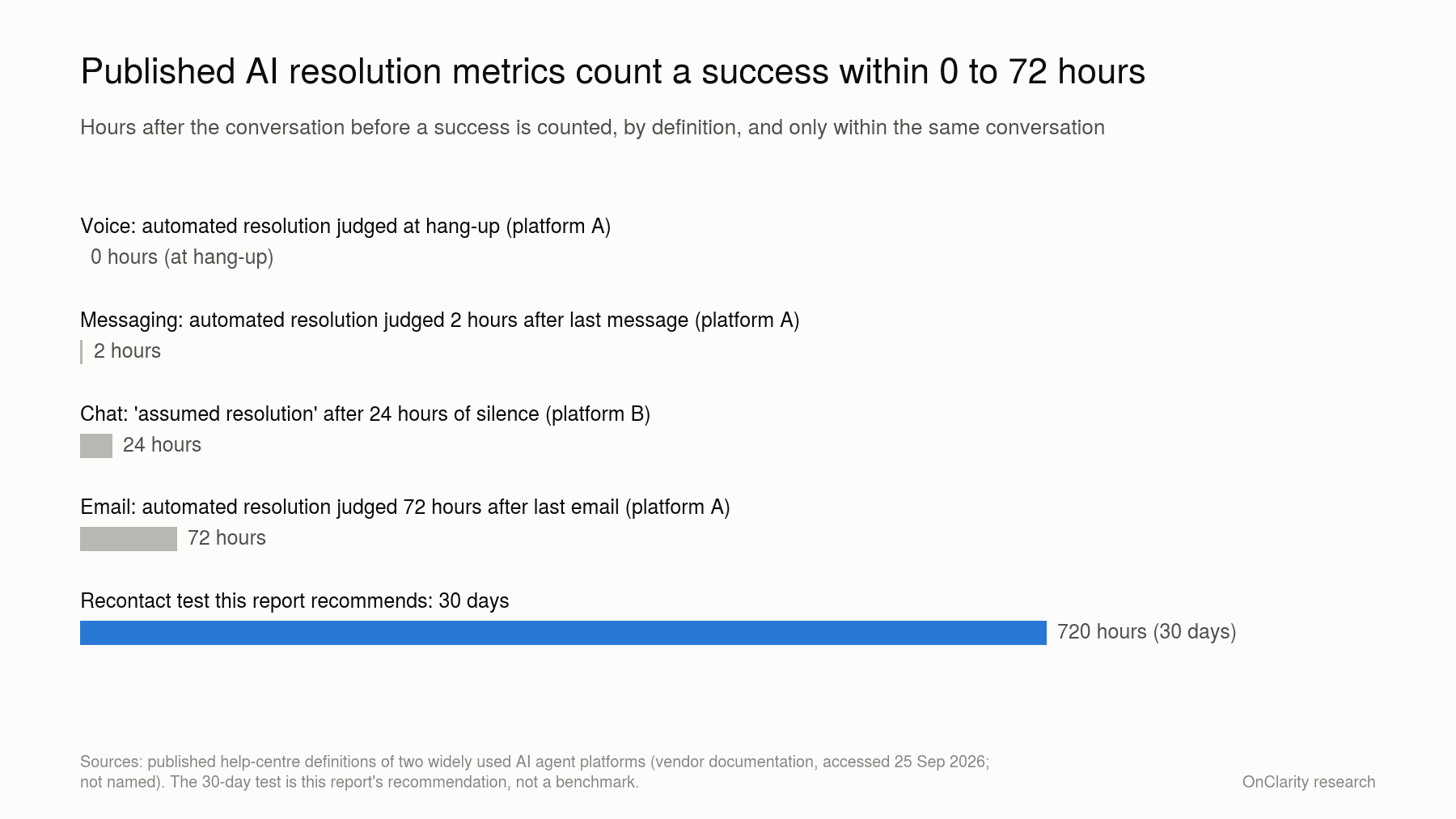
Chart 4. Data: chart-4-how-long-metrics-watch.csv. Sources: published help-centre definitions of two AI agent platforms (vendor documentation), accessed 25 September 2026.
What is the difference between containment, deflection and resolution?
They measure different things, and none of them measures whether the problem stopped. The table sets out the five metrics a CFO will meet in an AI business case.
| Metric | What it counts | Who usually reports it | What it leaves out |
|---|---|---|---|
| Containment | Contacts handled by automation without transfer to a human | The automation vendor or the channel team | Whether the problem was solved; a customer who gives up counts as contained |
| Deflection | Would-be contacts diverted to self-service, such as article views | The self-service or knowledge team | Whether the same customer arrived later through another channel |
| Automated resolution | Conversations judged resolved by the AI system, by a model check or by customer silence | The AI vendor, often as the billing unit | Any recontact in a new conversation or channel; whether the cause was removed |
| First contact resolution (FCR) | Issues resolved at first contact, by survey or by checking for a repeat within a window | Operations and quality teams | Problems the customer stopped reporting; repeats outside the window |
| Recontact rate | Customers who contact again about the same issue within a set window, in any channel | Rarely reported | Silent customers who give up without contacting again |
How do AI platforms define a resolution?
By the conversation, not by the customer. One widely used platform ends a messaging conversation two hours after the last message, then has a language model judge whether it was resolved. Email conversations end after 72 hours; voice ends at hang-up.
Only conversations that were not escalated are evaluated for automated resolution on that platform (vendor documentation, accessed September 2026).
A second platform counts a resolution when the customer says something like “Ok thanks,” or leaves without asking for more help. Silence for 24 hours counts as an “assumed resolution.”
That second platform deducts a resolution only if the customer returns to the same conversation (vendor documentation, accessed September 2026). A new chat, an email or a phone call about the same problem does not reverse it.
Neither definition is dishonest. Both are clear about what they count. The problem is what finance assumes they count.
What does that look like for one customer?
The example below is illustrative. It is built from the published definitions above, not from any company’s data.
| Day | What happened | What the dashboard recorded |
|---|---|---|
| 1 | A customer's card payment is declined. She asks the chat assistant, gets the steps to update her billing address, and types "ok thanks." | 1 conversation, 1 confirmed resolution |
| 4 | The payment fails again. She emails. The assistant sends the same help article. She does not reply. | 1 conversation, 1 automated resolution after 72 hours |
| 9 | She calls. The voice assistant walks her through the same steps. She hangs up. | 1 conversation, 1 resolution at hang-up |
| 10 | She moves the subscription to a competitor's card. | Nothing |
The dashboard shows three conversations, three resolutions and no escalations. The customer came back twice about one problem that was never fixed. The cause, a stale address check in the payments rule, is still live for every other customer who hits it.
Why does this matter to the P&L?
Because each of those resolutions can be a billed unit and a reported saving, while the cost of the problem keeps recurring. A leader can report a rising resolution rate and a rising cost to serve in the same quarter, and both numbers will be true.
Practitioners see the gap. 54% of contact centre leaders say AI-assisted interactions need their own quality framework (ICMI, State of the Contact Center 2026).
Brad Cleveland, writing for ICMI in August 2026, put the alternative in one sentence: “The rest measure contacts. The best measure why contacts happen.”
The practical test is simple. Next to every resolution rate, ask for the share of those customers who contacted you again about the same issue within 30 days, in any channel.
Resolved is a property of a conversation; fixed is a property of a problem.
5. What to measure instead

Chart 5. Data: chart-5-where-repeat-contacts-start.csv. Source: SQM Group, page updated August 2026; underlying sample and year not disclosed.
How big is the repeat problem?
Large enough to carry an AI business case on its own. SQM Group’s 2026 benchmark puts first-contact resolution at 71%, which means 29% of customers must contact the organisation again about the same issue.
Counted across channels, it looks larger. SQM’s customer research puts one-contact resolution at 59%, meaning 41% of customers contacted more than once to resolve the same problem (SQM Group, research year not stated).
Each repeat has a price. ContactBabel’s 2026 US Contact Center Decision-Makers’ Guide puts the average inbound call at $7.20.
And repeats cost customers. 70% of US adults say they are likely to switch or leave when an issue needs multiple interactions (Shep Hyken, January 2026).
Where do repeat contacts come from?
Mostly from the company, not the agent. SQM attributes 49% of contacts not resolved first time to organisational policies, processes and procedures.
That matters for AI. An AI agent can answer faster than a person. It cannot change a refund policy, a billing rule or a broken screen. Automating the answer to a problem the company causes makes the problem cheaper to repeat, not less frequent.
How do you measure the ROI of AI in customer service?
Measure the cost of problems that come back, then measure how much of it went away. We propose three numbers, each defined so any team can compute it from its own data.
Repeat cost removed ($ and % of cost to serve). For every problem you fix, register the outcome you expect before the work starts. Then:
Repeat cost removed = sum, over loops closed on outcome, of (repeat contacts at baseline minus repeat contacts after the fix) x cost per contact
Count every channel. Use an eight-week baseline, adjusted for seasonality. A loop counts only when the outcome registered at its opening actually happened. That is what closing the loop has to mean: the outcome is measured, not assumed.
Time to know (hours). The time from the first customer signal about a problem to the moment the issue is raised with an owner who can fix it. It measures how long a problem runs before anyone is accountable for it.
High Value Loop rate (%). The value of high-value loops closed on outcome, divided by the value of all high-value loops whose test window has ended. It measures whether the fixes that carry the value actually worked.
Definitions for each term are in the glossary: repeat cost, time to know and High Value Loop rate.
How can a team start this month?
With data it already holds. No new tool is needed for the first pass.
Export 90 days of contacts from every channel with a customer identifier, a timestamp, the channel and a contact reason.
Define a repeat: the same customer, about the same issue, within 30 days, in any channel.
Calculate the recontact rate for each contact reason, then multiply repeat contacts by your cost per contact.
Rank reasons by repeat cost. Take the top three and give each a named owner outside the contact centre.
Register the expected outcome for each fix, with a date, before any work starts.
Fix at the source: the article, the policy, the product or the process. Then automate what remains.
Report repeat cost removed to finance each month, against the baseline finance agreed.
Put that number on the same slide as the AI invoice. An illustrative example shows the scale. A service operation handling 1,000,000 contacts a year, with one in four being a repeat, at a blended $6 per contact, spends $1.5 million a year on problems customers already reported. These inputs are illustrative, not a benchmark.
A problem that no longer exists costs nothing to answer.
Where AI is working
The evidence for AI in service is real, and it is strongest where AI helps people rather than replaces them.
Agent assist raises productivity. A field study of 5,179 support agents found a generative AI assistant raised issues resolved per hour by 14% (Brynjolfsson, Li and Raymond, Quarterly Journal of Economics, 2025).
Newer agents gain the most. In the same study, novice and lower-skilled agents gained 34%. Customers were more polite and less likely to ask for a manager, and fewer new agents quit.
AI beats no service at all. A 2026 field experiment with 44,614 shoppers found a generative AI pre-sale assistant raised sales by 16.3% compared with a message saying service was unavailable (Fang and co-authors, working paper, 2026).
That same experiment found no decline in customer ratings or product returns. For simple questions outside staffed hours, AI is plainly better than a closed door.
Simple self-service is improving. Forrester predicts one in four brands will see a 10% increase in successful simple self-service interactions by the end of 2026.
Some customers notice. In Metrigy’s survey of 503 US and Canadian adults in late 2025, 64.2% rated the service they received good or excellent, up from 55.3% a year earlier.
Capacity has grown. 55% of service leaders report stable staffing while handling higher customer volumes (Gartner, December 2025).
The pattern is consistent. AI works when it speeds up a person, answers a simple question at 3am, or handles an intent with one right answer. It struggles when the answer depends on a policy, a system or a decision nobody has made yet.
Frequently asked questions
What is AI in customer service?
AI in customer service is software that answers, routes or helps resolve customer questions. It covers chat and voice assistants that talk to customers, assistants that help human agents in real time, and analytics that read conversations at scale. Generative AI is the newer layer: models that write answers in natural language rather than choosing from scripts. The evidence in this report covers all three.
How many companies use AI in customer service?
Adoption is widespread and rising fast. Deloitte Digital’s 2026 survey found 35% of contact centres already use autonomous AI agents in operations, and Gartner reports AI spending in service rising far faster than service budgets. Customer use has not kept pace. Gartner found only 7% of customers used a chatbot in their last service interaction in early 2026.
How do you measure the ROI of AI in customer service?
Start with cost, not activity. Containment and automated resolution count conversations, so they overstate savings when customers come back. Measure recontact within 30 days in every channel, multiply repeat contacts by cost per contact, and track how much of that repeat cost disappears after each fix. Agree the baseline with finance before the project starts, and count only outcomes that happened.
What are the benefits of AI in customer service for customers?
The clearest benefits are speed, availability and simple answers. In a field study of 5,179 agents, those with an AI assistant resolved 14% more issues per hour, and customers asked for a manager less often. AI assistants can also answer simple questions at any hour. The limit is accuracy: customers still need a clear route to a person.
How should you implement AI in customer service?
Fix before you automate. Find the contact reasons that come back often, remove their causes in policy, product or process, and then automate the questions that remain. Start AI with agent assistance and narrow, testable intents. Give customers a visible route to a person, and judge every deployment on recontact and cost, not on the vendor’s resolution rate.
Method, sources and limits
Question. What does independent research from 2025 and 2026 say about the results of AI in customer service?
Inclusion rules. We included research published from January 2025 onwards by analysts, academics, industry bodies, consultancies and public institutions, with a stated sample wherever the publisher disclosed one. Every number in this report comes from a page we opened on 25 September 2026. Search snippets and secondary summaries were not used as sources.
What we counted. The report draws on 35 dated sources. Of these, 33 are independent and 22 are primary research with a stated sample. Two are vendor help-centre pages, labelled “vendor” and used only to show how resolution is defined. One Gartner release from December 2024 appears as context and is dated as such.
What we excluded. Research published by customer service software vendors about their own category, statistics compiled on vendor blogs, and figures we could not trace to an original page. We cite Gartner only through its public newsroom.
Known limits. The majority of sources are surveys, which record what people say, not what they do. Samples, dates and definitions differ, so numbers from different studies should not be added or compared directly. ACSI measures satisfaction across the whole economy, not service alone, and its movements have economic causes. SQM Group does not disclose the sample or year behind its sources-of-error split, and Execs In The Know, Deloitte Digital, CX Network and ICMI do not publish sample sizes on the pages we cite. No OnClarity customer data or OnClarity statistic is used.
Corrections. If a figure here is wrong or has been updated, tell us and we will correct the page and note the change.
About this report
This report opens a six-month OnClarity programme on how customer service proves its value in the AI era. OnClarity (www.onclarity.com) builds AI software for customer service. For that reason the report uses only independent numbers, shows the evidence that cuts the other way, and states its limits. The definitions proposed in chapter 5 are free for any team to use.
Sources
Every source was opened on 25 September 2026. Vendor pages are labelled and were used only to show how resolution is defined.
Spend and adoption
Gartner (newsroom), Survey finds AI spending by customer service leaders has surged by 38%, despite overall service and support function budgets rising by just 2%, 26 Aug 2026. Independent; 199 service leaders, Apr to May 2026.
Gartner (newsroom), Survey finds customers are 3x more likely to use third-party GenAI than company-provided chatbots for customer service, 8 Jul 2026. Independent; 3,566 customers Feb to Mar 2026; 1,303 senior leaders Jan to Apr 2026.
Gartner (newsroom), Survey finds 91% of customer service leaders under pressure to implement AI in 2026, 18 Feb 2026. Independent; 321 leaders, Oct 2025.
Gartner (newsroom), Predicts over 50% of customer service organizations will double their technology spend by 2028, 31 Mar 2026. Independent; 321 leaders, Oct 2025 (Potosky quote).
Gartner (newsroom), Survey finds only 20% of customer service leaders report AI-driven headcount reduction, 2 Dec 2025. Independent; 321 leaders, Oct 2025.
Gartner (newsroom), Survey reveals 85% of customer service leaders will explore or pilot customer-facing conversational GenAI in 2025, 9 Dec 2024. Independent; context only (pre-2025); 187 leaders, Jul to Aug 2024.
Deloitte Digital, 2026 Global Contact Center Survey (press release), 9 Jun 2026. Consultancy; sample not published on page.
McKinsey & Company, The State of AI: global survey 2026, 25 Aug 2026. Independent; 1,719 respondents, 97 countries, May to Jun 2026.
BCG, AI Radar 2026: as AI investments surge, CEOs take the lead, 15 Jan 2026. Independent; 2,360 executives incl. 640 CEOs, 16 markets.
Federal Reserve Bank of Richmond, What CFOs say about AI adoption (Duke University and Federal Reserve CFO Survey), 20 May 2026. Independent; 750 firms.
Customer experience
American Customer Satisfaction Index, U.S. overall customer satisfaction (quarterly national scores), accessed 25 Sep 2026. Independent; about 200,000 interviews a year.
American Customer Satisfaction Index, National ACSI Q2 2026 press release, 11 Aug 2026. Independent.
Institute of Customer Service, UK Customer Satisfaction Index, July 2026 (press release), 7 Jul 2026. Independent.
Institute of Customer Service, UKCSI research page, accessed 25 Sep 2026. Independent.
Forrester, Have we turned the corner on CX quality? (2026 CX Index), 2026. Independent; 224,000+ customers, 462 brands, 13 countries.
Forrester, 2025 Global Customer Experience Index rankings, 24 Jun 2025. Independent; 275,000+ customers, 469 brands.
Gartner (newsroom), Survey finds only 27% of customers would try a chatbot again after a negative experience, 2 Sep 2026. Independent; 3,566 customers, Feb to Mar 2026.
Gartner (newsroom), Survey finds 87% of customers say companies using GenAI for customer service must provide access to a human agent, 4 Aug 2026. Independent; 3,566 customers, Feb to Mar 2026.
Shep Hyken (Shepard Presentations), 2026 State of Customer Service and CX, Mar 2026. Independent; 2,226 US adults, 5 to 9 Jan 2026.
Metrigy, Study: 85% of consumers prefer interacting with humans vs AI agents for customer service, 18 Feb 2026. Independent analyst; 503 US and Canadian adults, Nov 2025.
Return on AI
PwC, 29th Global CEO Survey, 19 Jan 2026. Independent; 4,454 CEOs, 95 countries, Sep to Nov 2025.
Bain & Company, Your AI budget is growing. Your returns aren’t. Here’s why., 1 Jun 2026. Independent; 951 companies.
Gartner (newsroom), Autonomous business and AI layoffs may create budget room, but do not deliver returns, 5 May 2026. Independent; 350 executives, $1bn+ companies, Q3 2025.
Execs In The Know, The ROI Imperative: building the business case for exceptional CX, 31 Jul 2026. Independent industry community; sample not published on page.
CX Network, How practitioners are spending their CX budgets in 2026 (CX Horizons), 2026. Independent media; sample not published on page.
Deloitte, CFO Signals, Q2 2026, 23 Jul 2026. Consultancy; 200 North American CFOs, $1bn+ companies.
Metrics and repeat contacts
ICMI (Brad Cleveland), State of the Contact Center 2026: the best contact centers outgrow traditional metrics, 3 Aug 2026. Independent industry body; sample not published on page.
SQM Group, First call resolution: metric and operating philosophy, updated 20 Aug 2026. Benchmarking firm; sample and year behind sources-of-error split not disclosed.
SQM Group, Call center customer experience research, research year not stated. Benchmarking firm; undated.
ContactBabel, The 2026 US Contact Center Decision-Makers’ Guide, 2026. Independent research firm; 207 US organisations and 1,000+ consumers.
AI agent platform A (help centre), About automated resolutions for AI agents, accessed 25 Sep 2026. Vendor documentation, used for the definition only.
AI agent platform B (help centre), AI agent resolutions and outcomes pricing, accessed 25 Sep 2026. Vendor documentation, used for the definition only.
Where AI is working
Quarterly Journal of Economics / NBER (Brynjolfsson, Li, Raymond), Generative AI at Work, 2025 (QJE 140(2)). Independent academic, peer reviewed; 5,179 support agents.
arXiv (Fang, Yuan, Zhang, Donati, Sarvary), Generative AI and Sales Productivity: Field Experiments in Online Retail, 30 Jun 2026 version. Independent academic working paper; RCT, 44,614 consumers.
Forrester (blog), 2026: the year AI gets real for customer service, but it’s not glamorous work, late 2025. Independent; prediction.