OnClarity Insights
The AI bill is due. Customer service is where it gets paid
Boards funded AI in customer service for two years. In the 2027 budget round, that line has to pay for itself. In service, it only does when the same problem stops coming back.
6 min read





The short answer
Customer service put more of its budget into AI than any other function, and only a quarter of service leaders can show a financial return. There are three places to pay that bill: fewer people, cheaper contacts and fewer contacts. Only the third keeps paying every month after. Measure it as repeat cost removed, on your own data, and build the case conservatively.
Why is the AI bill due now?
Because the money went in faster than the return came out, and the people who approved it are now asking.
More than half of CEOs (56%) say their company has seen neither higher revenues nor lower costs from AI, according to PwC’s 29th Global CEO Survey of 4,454 CEOs, published in January 2026.
Service sits at the front of that queue. In July 2026 Gartner reported that service and support leaders put a median 12% of their 2025 budget into AI, the highest of the ten functions it looked at, and that only 24% of them could show positive financial returns across their AI use cases.
The gap is widening. In August 2026 Gartner reported that AI spending by service leaders rose 38% in a year while overall service budgets rose 2%.
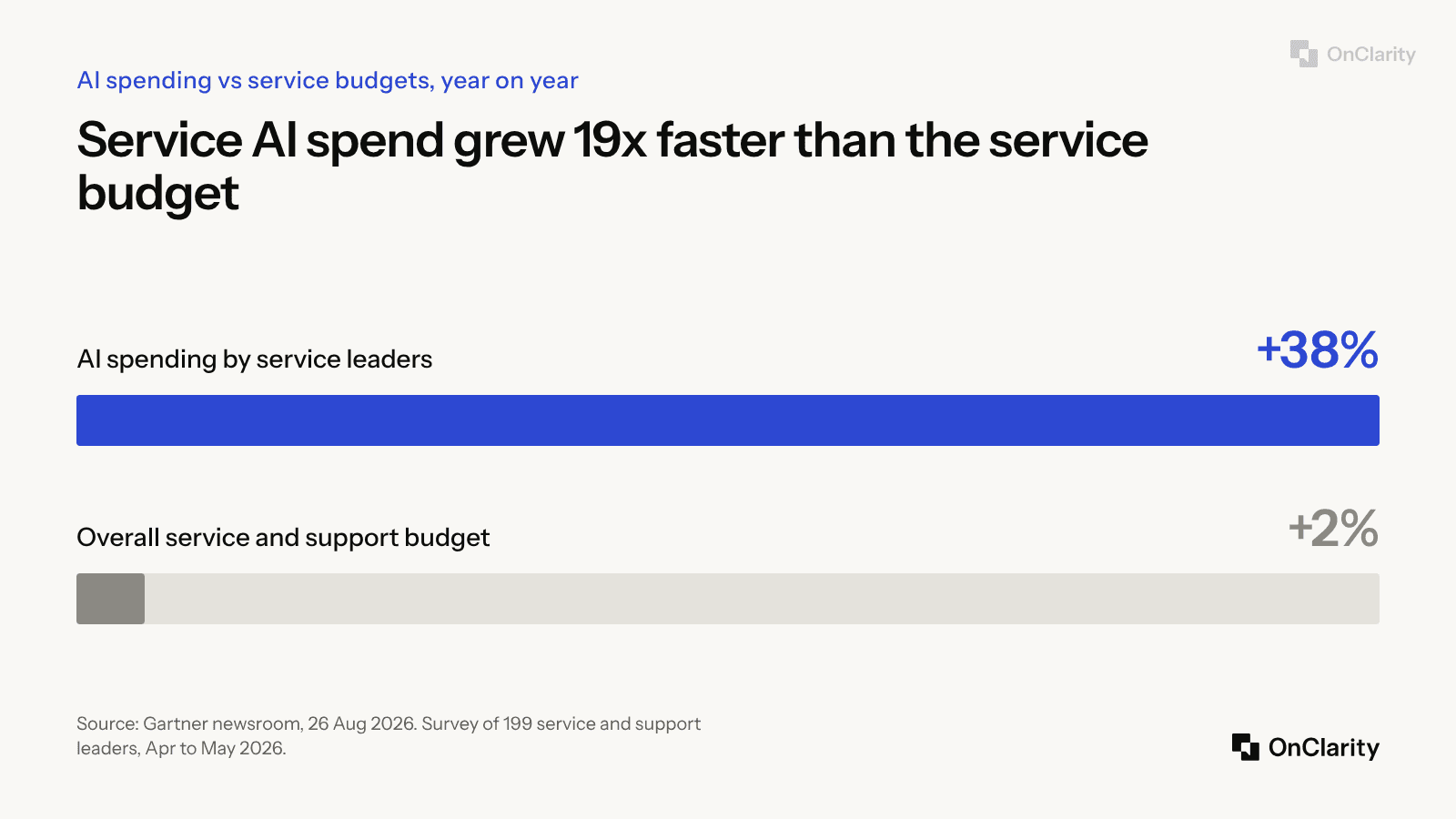
Source: Gartner newsroom, 26 Aug 2026 (survey of 199 service and support leaders, Apr to May 2026).
When spend grows nineteen times faster than the budget it sits in, something else in the budget pays for it. That is the bill. The 2027 planning round is when finance asks what it bought.
Where can a service organisation pay the AI bill from?
There are three places. They are not equal.
1. Fewer people
This is the line most business cases were built on. It is also the one that holds least. In March 2026 Gartner reported that only 20% of service organisations had actually reduced agent headcount because of AI, and its analysts described many of the cuts that did happen as cutting agents to fund AI rather than because AI was ready to take over. The work does not disappear. The simple contacts go to the AI and the people who are left handle the hardest ones.
2. Cheaper contacts
This is the line most AI pricing is built on: a lower cost for each conversation or each resolution. It saves money once, on each contact, and it assumes the price stays low. Gartner predicts that by 2030 the cost per resolution for generative AI will exceed $3, higher than many offshore human agents in consumer service (January 2026).
There is a quieter problem. If the same customer comes back about the same issue next week, the business pays again. Automating a problem that keeps returning only makes it cheaper to have it again. Under per-resolution pricing, a problem that comes back can be counted, and billed, as a new resolution.
3. Fewer contacts
This is the contact that never happens, because someone fixed the reason the customer had to get in touch. It costs nothing. It keeps costing nothing every month the fix holds. A cheaper contact saves money once. A fixed problem saves it again every month after.
That is why, in customer service, the AI bill gets paid in the third place or it does not get paid. For the worked arithmetic of cheaper contacts against fewer contacts over three years, see If AI costs nearly as much per contact as a person, where is the saving?.
What will a CFO accept as the return?
A number the finance team can check line by line. In practice that means four things.
The company’s own data. Not a vendor benchmark, not a dashboard rate. Contacts, repeats and cost from the company’s own systems.
A baseline finance signed. Eight weeks of contacts across every channel, adjusted for seasonality, agreed before anything changes.
A conservative case. A business case that shows a huge difference is a business case nobody believes. Use the low end of every assumption and say which ones they are.
One of three outcomes. Executives fund more revenue, lower cost or lower risk. A feature list is not one of them.
The metric that meets all four in service is repeat cost removed.
How do you calculate repeat cost removed?
Repeat cost removed = for every problem fixed and confirmed fixed, (repeat contacts at baseline minus repeat contacts after the fix) x cost per contact.
A repeat is the same customer back about the same issue within the window, in any channel. A fix only counts once the outcome you wrote down before the change has happened and held through its test window. Report it in money and as a share of cost to serve.
An illustrative example, with round numbers. These are assumptions, not a benchmark.
Three things make this a conservative number. Only fixes that held through their test window count. Fixes still inside their window are reported separately and left out. And nothing is claimed for the contacts the fixes will prevent next year, even though that is where the compounding sits.
What three questions should leaders ask in the budget review?
What share of our contacts is the same customer coming back about the same issue, in any channel, within 30 days?
What does that cost us, at our own cost per contact?
Which fixes removed repeats last quarter, against a baseline finance signed, and did they hold?
If the answer to the first is “we don’t know”, that is the first finding. Most service reporting counts contacts handled and conversations resolved. Very little of it counts the problems that came back.
The honest trade-off
AI does cut the cost of simple contacts, and some headcount savings are real. Fixing problems at the source is slower than buying an AI agent: it needs product, operations and knowledge owners to change something, and the first quarter’s saving is smaller than an automation case promises. The order still matters. Fix first, then automate what is left. The other way round, you pay to automate problems that should have stopped.
What to do this week
Pull eight weeks of contacts from every channel, with customer and reason.
Mark the repeats: same customer, same issue, within 30 days.
Price them at your own cost per contact and show the total to finance.
Pick the five drivers that cost most, and write down the outcome you expect for each before anyone changes anything.
Run your own numbers. The OnClarity AI Return Model simulates your contact centre month by month, including repeats, and lists the assumptions it used so finance can check them. Or book a working session and bring your contact data.
Questions people ask
Is AI in customer service paying off?
For most companies, not yet in a way finance can see. Gartner reported in July 2026 that only 24% of service and support leaders could show positive financial returns across their AI use cases. The gap is usually measurement: dashboards count answers and resolutions, not the problems that stopped.
What is repeat cost?
Repeat cost is what a business spends handling the same customer coming back about the same issue. It is counted across every channel, within a fixed window, at the company’s own cost per contact. Repeat cost removed is the share of it that went away because a fix held.
Should we cut agents to fund AI?
Be careful. Gartner reported in March 2026 that only 20% of service organisations had actually reduced headcount because of AI. When AI takes the simple contacts, the people who remain handle harder ones. Fund AI from contacts that stop happening, not from people you will need again.
Sources
PwC, 29th Global CEO Survey, 19 Jan 2026.
Gartner newsroom, survey release on third-party GenAI use (24% positive returns; median 12% of 2025 budget), 8 Jul 2026.
Gartner newsroom, AI spending by customer service leaders up 38%, 26 Aug 2026.
Gartner newsroom, over 50% of service organisations will double technology spend by 2028 (20% reduced headcount), 31 Mar 2026.
Gartner newsroom, GenAI cost per resolution will exceed $3 by 2030, 26 Jan 2026.
ContactBabel, The 2026 US Contact Center Decision-Makers’ Guide (average inbound call $7.20), 2026.
The example above is illustrative. It uses round numbers and labelled assumptions, not OnClarity customer data.