

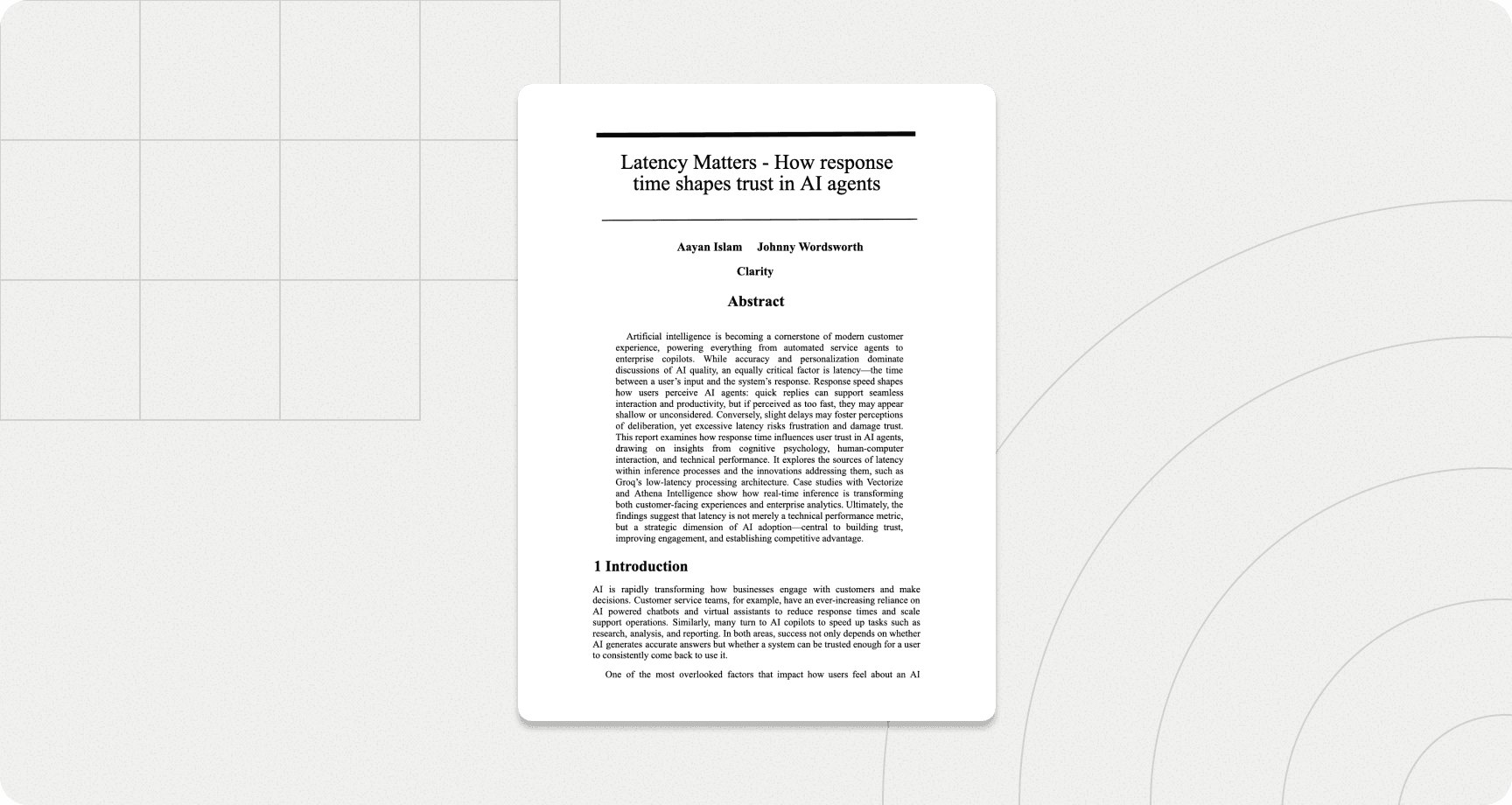
Artificial intelligence is becoming a cornerstone of modern customer experience, powering everything from automated service agents to enterprise copilots. While accuracy and personalization dominate discussions of AI quality, an equally critical factor is latency—the time between a user’s input and the system’s response. Response speed shapes how users perceive AI agents: quick replies can support seamless interaction and productivity, but if perceived as too fast, they may appear shallow or unconsidered. Conversely, slight delays may foster perceptions of deliberation, yet excessive latency risks frustration and damage trust. This report examines how response time influences user trust in AI agents, drawing on insights from cognitive psychology, human-computer interaction, and technical performance. It explores the sources of latency within inference processes and the innovations addressing them, such as Groq’s low-latency processing architecture. Case studies with Vectorize and Athena Intelligence show how real-time inference is transforming both customer-facing experiences and enterprise analytics. Ultimately, the findings suggest that latency is not merely a technical performance metric, but a strategic dimension of AI adoption—central to building trust, improving engagement, and establishing competitive advantage.

